


The Learning Library
-
Allergy Induced Fatigue and Sleep Problems
Sleep & Fatigue: Your Allergies May Be A Factor Rest Well By Dr. Zedalis Over the last several years, more individuals have realized that they suffer with allergies and sleep-related problems. Patients who have upper respiratory infections often suffer from significant fatigue and sleepiness, as well as have concentration problems. Most physicians assumed that this relation was due to a complex mixture of chemicals that caused both the respiratory infections (colds) and the fatigue. However, it has been discovered that allergy-induced fatigue is due to a more fundamental process. Both children and adults with allergies experience a fragmented process of sleep instead of continuous deep sleep. As a result, these individuals suffer from a reduction in sleep quality and quantity. This reduction in sleep quality and quantity affects children by causing irritability and poorer performance in school. Interestingly, these children often appear relatively alert and show no obvious signs of inadequate sleep. They do not appear to be visibly sleepy and usually fight going to bed. However, when they are placed in darkened rooms with stimuli removed, they fall asleep rapidly. Adults, on the other hand, are more able to recognize when they are excessively sleepy and are more likely to take appropriate action to improve their sleeping habits. Unfortunately, many adults do not make the connection between allergies and daytime sleepiness. Continue reading →
 -
Allergen Control Vacuums
The Best HEPA Vacuums For Controlling Allergens What Is House Dust? Why Doctors Recommend HEPA Vacuum Cleaners for Controlling Dust and Other Allergens? What Vacuum Technologies are Available? What Type of HEPA Vacuum is Right for Me? Comparison Chart for HEPA Vacuum Cleaners Tips for Vacuuming Your Home What Is House Dust? I try to vacuum regularly with a HEPA vacuum cleaner, or at least when I know company is coming over. Whenever I use my Miele HEPA vacuum cleaner, I can see and even breathe the difference, but just what is all that dirt and fuzz? Research shows that about 70-90% of what we vacuum up is gray/brown dust that contains a significant amount of dead skin cells. Somewhere between 5 and 25% of that debris is carpet or smaller fibers that have been loosened by traffic or by the mechanism of the vacuum itself. About 5% of the waste collection is hair. The remaining vacuumed debris is actually what can be the most dangerous for allergy sufferers, containing fur, food particles, insects, mites, sand and mineral dust, pollen and other plant parts, carbon and other pollution particles, and paper and packing materials. Other vacuumed microbes include soil and skin organisms, and bacteria and mold spores like penecillium, ascoporium, aspergillus and alternarium. There may even be allergenic animal dander – even if there is no pet in the home. Continue reading → -
Chronic Sinusitis
Chronic Sinusitis Facts & Causes Of Acute Sinusitis, Chronic Sinusitis Some Basic Facts About Sinusitis For anyone who has experienced sinusitis, it is a miserable experience. Sinusitis is the inflammation of the sinus cavity. Your sinuses are the openings in the bones around your nose. Everyone has four pairs of sinuses that are connected to the nasal cavity by small openings. They are lined with the same type of membranes that line the inside of the nose, and when they are working properly, air flows in and out of the sinuses, and fluid and mucous drains from the sinuses into the nose. Inflammation of one or more of the cavities inhibits this process, so the mucous and membranes become infected, and sinusitis results.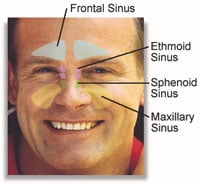 There are two general types of sinusitis - acute sinusitis and chronic sinusitis. The main difference between acute and chronic sinusitis is the frequency and length of infection. Acute sinusitis happens sporadically, lasts only a few weeks, and often follows a respiratory infection such as a cold. Chronic sinusitis is defined as sinus inflammation that persists for two months or longer. Although acute sinusitis symptoms are often more severe, sufferers of chronic sinusitis run a higher risk of sinus tissue damage. Continue reading →
 -
Dust Mite Treatments
Dust Mites Treatments and Products for Your Home Are Dust Mites Causing My Allergy Symptoms? I've Encased My Bedding, Now What? Which Dust Mite Treatment Product is Best for Me? Helpful Tips for Vacuuming and Dusting How Can I Be Sure I Have a Dust Mite Problem? Are Dust Mites Causing My Allergy Symptoms? The short answer is...quite possibly. Remember that dust mites are microscopic organisms that love warm, humid, and fibrous environments where there is plenty of food (they primarily eat our shed, dead skin cells, and other organic matter like mold spores). Although they avoid human contact, dust mites rapidly-produce a waste product that is easily inhaled, causing airways to become hyper-responsive in mite-sensitive individuals. Regardless of how well you clean, dust mites are simply a part of the environment and, therefore, extremely prevalent in nearly all homes. Continue reading → -
Dust Mite Proof Covers
What Are Mite Proof Encasings? Maybe you've asked, "Can I help protect myself and my family from asthma and allergies?" The answer is Yes! Microscopic dust mites, often the proven causes of allergic symptoms such as sneezing, sniffling, and swollen, itchy nose and eyes, are alive and well in most every bedroom, regardless of how fastidiously you clean. Allergy specialists and even some medical studies state that using zippered mattress covers on your mattress, pillows & box spring will help stop dust mite allergens lurking within your bedding from becoming airborne and breathed in while you sleep. Unlike the uncomfortable plastic covers of the past that were hot and crinkly, ours are cool and extremely comfortable - a real pleasure to sleep on. Like an invisible shield, they completely trap mites and their allergen inside the cover to give you the perfect barrier of protection while extending the life of pillows and mattresses. Today's covers are made of soft, comfortable, breathable fabrics that protect you and pamper you, too! Continue reading → -
Allergen-Proof Bedding Covers
Why Doctors Recommend Allergen-Proof Encasings About 20 years ago, researchers began to wonder what could be done in the home environment to help control the allergen triggers that cause asthmatic and allergic reactions. Because we spend one-third of our lives in our bedroom, it seems like the natural environment in which to focus. Tests were done in which one group got zippered allergen-proof bedding encasings, while the control group had no encasings. The results of even such simple tests were dramatic. Continue reading → -
About Dust Mites
Facts About Dust Mites and Dust Mite Encasings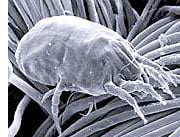 Dust mites are microscopic organisms closely related to spiders and ticks. Dust mites thrive in the warm, humid, dark conditions inside the fibrous materials that fill our homes: bedding, upholstered furniture, carpet, stuffed toys, and old clothing. Dust mites are scavengers that feed primarily on the dead skin that falls off the bodies of humans and animals. So, it's no wonder that they crowd around the places where we spend most of our time. It's not actually the dust mites that cause the sneezing, coughing, runny noses, stuffy noses, and congestion that plagues 20 million Americans. It's their even smaller waste particles. While the dust mites are feasting on dead skin cells deep inside our pillows, mattresses, and carpet, the things we do every day, like walking across the room, turning over in bed, and vacuuming, stir up dust mites' tiny waste particles for us to breathe. That's why it's important to cover your mattress and pillows with dust mite encasings with pore sizes in the range of 2 to 10 microns. Encasings with larger pore sizes may let dust mite allergen or dust mites themselves through, and encasings made with vinyl may not allow heat and moisture to escape easily. All of the encasings offered by National Allergy have a mean pore size within the recommended range of 2 to 10 microns. Additionally, all Independent tests of pore size by PMI, Inc. show that BedCare™ mattress and pillow encasings can also be used for bed bug protection*. Independent test data proved bed bugs and their eggs could not get through our fabrics or zippers. Continue reading →
 -
Air Purifiers
Indoor Air Cleaning & Filtration Technology What Makes Air "Unhealthy"? When a shaft of light shines into your living room, you've most likely noticed the particles floating in its beam. If you're like most, you're probably not thrilled to realize you're breathing those particles. And just what are they, anyway? There are three main components to unhealthy indoor air: particulate matter, micro-organisms and volatile organic compounds (or V.O.C.s). Common indoor particles include things like pollen, lint, smoke, house dust and animal dander. In fact, even homes that don't have pets probably still have dander in the air! It was recently published in the Journal of Allergy and Clinical Immunology that pet allergen is present in ALL homes, regardless of whether an animal is even present. Common airborne micro-organisms can include plant and mold spores, viruses and bacteria. Other indoor air pollutants include chemicals, gases and fumes like asbestos, carbon monoxide, formaldehyde, lead, nitrogen dioxide, as well as volatile organic compounds emitted from household cleaning products, furniture, smoke and cooking odors. While this extensive list of potential household air contaminants may seem daunting, there are filtration technologies available to help limit your exposure to harmful indoor air. Continue reading → -
Pollen Allergies
Pollen Allergies and Minimizing Pollen Allergy Symptoms Who, What, When, Where, and Why? 35.9 million Americans suffer from seasonal allergies or pollen allergies. With spring finally here, so are the symptoms of seasonal allergic rhinitis and pollen allergies- sneezing, runny noses, congestion, itchy sinuses, and watery eyes. What Causes Rhinitis & Hay Fever: Seasonal allergic rhinitis or hay fever is caused... -
Pet Dander
Pet Allergies Pet Allergies - Myths, Facts, and Avoidance Animal dander allergies - how big is the problem? According to studies published in the Journal of Allergy and Clinical Immunology, scientific journal of the American Academy of Allergy, Asthma, and Immunology (AAAA&I), up to 10% of the general population and 40% of allergic individuals react to cats and dogs. Allergy...