


Winter Allergies
Closing Up For Winter - 5 Strategies For Surviving Indoor Allergens
1. Replace Or Clean Your Furnace Filter
A good furnace filter can capture both nuisance particles and allergens. For best results, if you have a standard 1-inch disposable filter, you should replace it every 3 months. We highly recommend the 3M Filtrete Ultimate filter for its efficient removal of allergens. Any disposable furnace filter should have a MERV rating of 11 or higher to be an effective filter. If you have a permanent electrostatic filter, this is a good time to remove and clean it, so there is no restriction of airflow as you head toward winter.
Recommended Products:
2. Change The Filters In Room Air Cleaners
Let's face it, we don't all follow the manufacturer's recommendations for changing the filters in our room air purifiers. But the truth is that when the pre-filters and primary filters aren't changed at the recommended intervals, you are not benefiting from the cleanest air you could be breathing. In addition, you could be endangering the life of your air purifier's motor.
 The HEPA filter is the most important part of your machine. When this pleated, high-efficiency filter is properly maintained, it captures 99.97% of particles down to .3 microns - that's just about EVERY allergen. Most air purifiers, like Austin Air, and older Honeywell models, recommend changing the HEPA filter every 1-3 years. More recent Honeywell machines come with permanent filters, so if you have one of these, this month is probably a good time to vacuum your filter using a sealed HEPA vacuum (so you don't release the particles your filter has trapped back into the air).
An air purifier's pre-filter traps large particles, dust bunnies, and some odors. A clogged pre-filter can really restrict the airflow of your purifier. Most are to be changed every 3-4 months, depending on usage. Austin Air pre-filters need only to be vacuumed for long-life use.
Recommended Products: **Remember, our subscriber special lets you save 10% on purifier replacement filters for models such as Austin Air, Honeywell.
3. Prevent Condensation & Energy Loss
Homes in colder climates are particularly prone to condensation during winter months. Condensation can give way to mildew around door and window frames, and for many, this is an irritating allergen that should be prevented if possible. Condensation happens when air with high relative humidity hits a cold window surface. The two ways to avoid this problem are to either lower the relative humidity of the house or raise the temperature of the window.
I'll talk about lowering relative humidity in a moment, but one way to increase a window's temperature and efficiency is to seal it. Also called weather-stripping (more commonly when it's done on doors), sealing windows can be accomplished with self-stick foam, available at most home improvement stores. Plastic window insulator kits are also available - be sure to wrap the plastic all the way around the frame of the window or door, then remove it in the spring.
Sliding windows can be a particular problem, especially when the tracks are aluminum, which transfers cold from the outside and forms condensation in the tracks. In the same way, you inspect and clean sliding shower doors to avoid mold and mildew, you should be careful about sliding doors and windows around the house that gather moisture.
Fall is also a good time to check under sinks, behind the refrigerator, or hot water heater for leaks. Any persistent leaking can be a recipe for mold growth and allergy irritation. While you're looking, make sure all your piping is insulated properly to prevent breakage due to freezing during the winter.
Recommended Products:
- NAS-12 Mildew Stain Remover
- No More Mildew Mold Sealant
- AllerTech® Dust Grabber Dusting Cloth
- 3M 8233 N100 Particulate Respirator
4. Maintain Low Relative Humidity
Home builders and window professionals agree that keeping your home's humidity low is a good way to prevent condensation. Like many allergy physicians, National Allergy also recommends keeping low home humidity in order to keep mold and dust mites in check.
 While fall and early winter mean drier, crisper air, for Georgia, it also means a significant amount of rain. Even now, the thunder is rumbling outside our office building, and our friends along the southern coastal areas are still dealing with tropical storm threats. Home humidity control is a major tactic in any allergen-avoidance strategy all year round. Experts say that the relative humidity in your home should range between 40% and 50%. Humidity control is easy to overlook in cooler months, but we should keep our homes at higher temperatures and spend more time indoors. Both situations mean more propensity for dust mites, which feed on our dead skin cells and love warm environments. Keeping low relative humidity in your home is one way to prevent dust mites and mold spores from finding as many places to thrive.
Recommend Products:
5. Be Careful When Unpacking Your Winter Storage
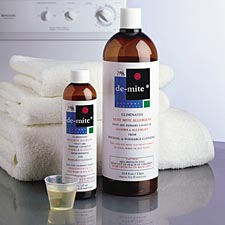
If you're like me, you have several big plastic containers in your attic or basement filled with sweaters, sweat pants, heavy socks, blankets and other items that haven't seen the light of day since March or April. I highly recommend cleaning (or dry-cleaning) these items before adding them back onto the bed or into the closet, especially if you did not wash them before packing up in the spring. These items could give you the sniffles in no time. Take care of dust mites and other allergens with hot-water washing or by using an anti-allergen additive or detergent. You can also use an anti-allergen home spray if you don't have time to get that sweater or blanket dry-cleaned.
 Regardless of what you are packing or unpacking, if you are dust mite sensitive like me, wear a mask if you're cleaning out the closet. Closet-cleaning is one of the few home chores that can make my allergies miserable for a few hours if I don't protect myself.
Recommended Products:
- Anti-Allergen Laundry Detergent
- De-Mite Laundry Additive
- Static-Eliminator Re-usable Dryer Sheets
- AllerSearch ADS Anti-Allergen Spray
- Silk Dust & Pollen Mask
Hopefully, you can find some time this fall to follow these simple strategies that will make your home healthier and more efficient throughout the coming months. Remember, you can make a world of difference in your family's health just by controlling allergens in the environment. Thanks for letting National Allergy help you along the way!